Genesal Energy designs a generator set for a waste-to-energy plant that transforms waste into resources
Genesal Energy’s strong commitment to sustainability has led the company to develop projects linked to renewable and green energy, such as the design of a generator set for a waste-to-energy plant located in the south of London.
This facility generates electrical energy through the incineration of waste, producing power from materials that cannot be separated or recycled. With the aim of reducing environmental impact and promoting reuse for energy generation, waste is transformed into energy through biomethanisation or incineration processes.
Taking this function into account, Genesal Energy’s engineering team designed a generator set intended to supply the auxiliary services of this power generation plant. Its role is to guarantee the electrical supply to the plant’s main turbine, enabling a black start, and to act as backup in the event of grid failures, ensuring continuous operation. This solution is essential to guarantee the safe operation of critical installations, where even a simple grid outage could lead to serious incidents, accidents or major breakdowns.
The project was carried out jointly with the client and the civil works subcontractor.
According to World Bank forecasts, global waste generation will increase by 60% by 2050. In addition, Eurostat data show that 24% of municipal waste in Europe is still sent to landfill, with the associated environmental and public health challenges. For this reason, the development of waste-to-energy plants is essential, as they give a second life to non-recyclable waste that would otherwise be difficult to manage from an environmental perspective.
A unique design to generate energy
According to data from the United Nations International Environmental Technology Centre, waste-to-energy processes have the capacity to reduce the volume of waste sent to conventional landfills by up to 90%. The report also highlights that in countries most advanced in the use of this technology, between 25% and 30% of waste is already being treated in this way.
Guarantee the safe operation of critical installations, where even a simple grid outage could lead to serious incidents, accidents or major breakdowns.
All of this data was taken into account by Genesal Energy’s engineering team when designing an open, non-soundproofed generator set, operating at medium voltage (11,000 V). The solution includes air silencers in the generator room, a large-capacity fuel tank and a remote cooling system installed on the rooftop, including heat exchangers, a secondary circuit circulation pump and an air cooler. A special structure was also designed to support this equipment on the roof of the client’s building.
The entire project was developed in close collaboration with the client, ensuring that both the operational performance and the installation procedures, as well as the overall functionality of the equipment, met the highest standards.
Engineering solution delivered
The project developed by our engineering department involved the design of an open, non-soundproofed generator set, operating at 11,000 V medium voltage, with air silencers in the generator room, a large-capacity fuel tank and remote rooftop cooling. This includes heat exchangers, a secondary circuit circulation pump and an air cooler, supported by a specially designed structure on the client’s rooftop.
The engineering of the project was carried out jointly with the client and the civil works subcontractor to ensure that operation, installation procedures and equipment performance were fully optimised.
Key features
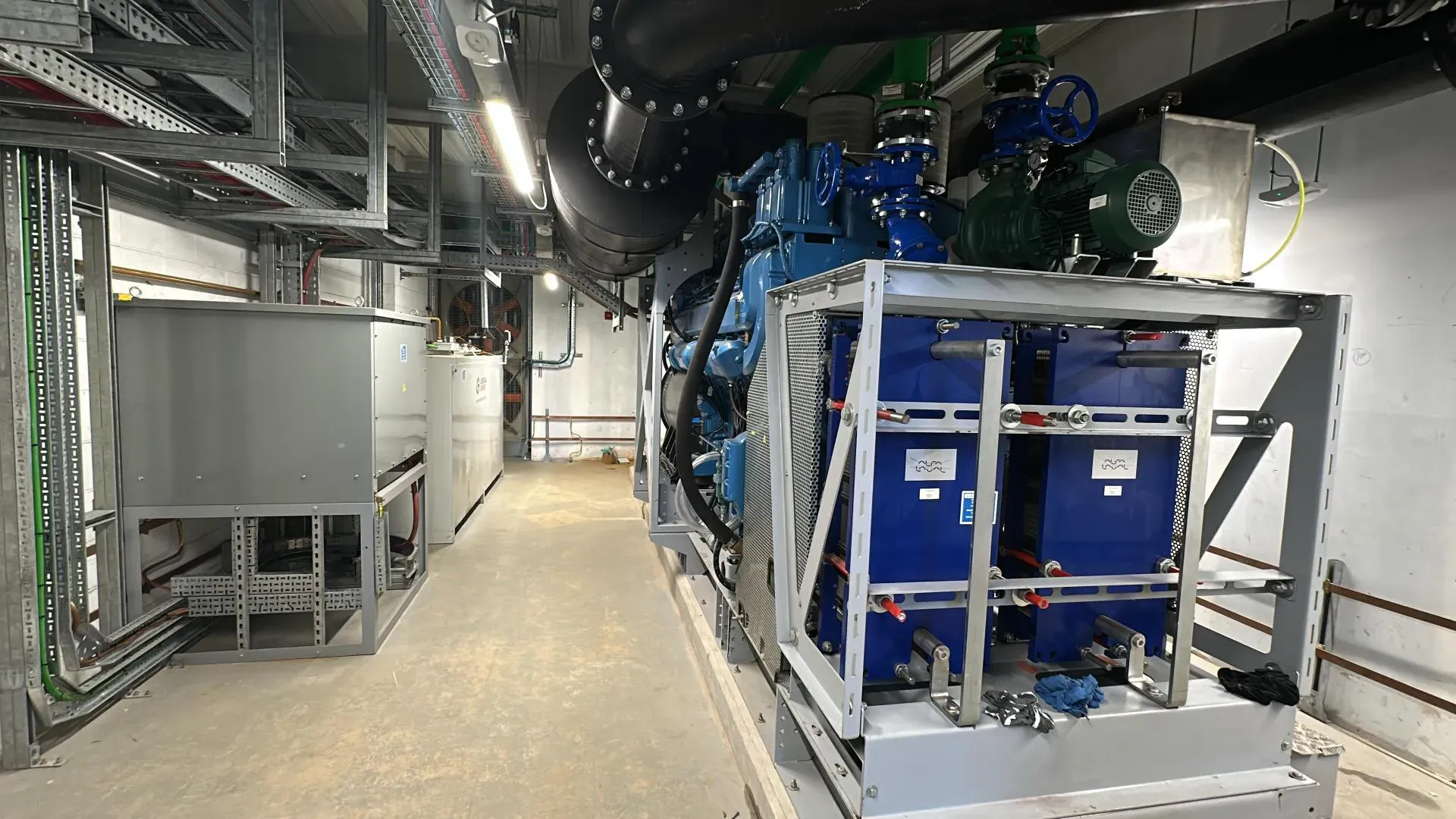
- 11,000 V medium-voltage generator with remote rooftop cooling, heat exchangers integrated into the baseframe, and pumping and filtration systems mounted on the generator skid.
- Air cooler installed 4 m above rooftop level for integration with the plant’s HVAC systems, including supporting structure, guardrails and access ladder.
- Generator room fuel system compliant with UK regulations and connected to the plant’s fuel installation.
- Integrated earthing resistor.
- Integrated room ventilation system with air intake and exhaust silencers to ensure high external noise attenuation.
- Integrated control system.
- Exhaust silencers mounted directly on the generator baseframe.
- Double-wall stainless steel chimney, painted to match the building façade for aesthetic integration.